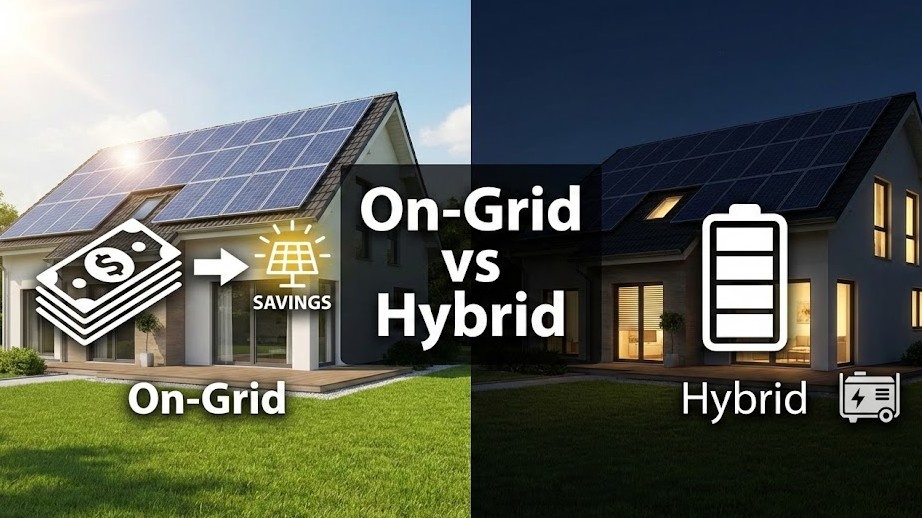
Choosing between an On-Grid vs Hybrid Solar System is the most important decision for Pakistani homeowners in 2025. Prices are high, electricity bills are increasing every month, and WAPDA load shedding creates stress for every family. That is why choosing the right type of solar system, On-Grid or Hybrid, is very important. Many homeowners get confused because both systems look similar, but they work very differently. In this guide, we will explain everything in simple English so you can make the best choice for your home in 2025.
Introduction: Solar is a Long-Term Investment, Choose Wisely
Solar panels are not cheap, and once you install a system, you expect it to run for 20 to 25 years. Because of this long life, your first decision must be correct. In Pakistan, especially in 2025, the biggest concern for homeowners is the combination of high electricity bills and frequent load shedding, depending on the area. Some areas like DHA, Bahria Town, and major urban centers have almost no load shedding. But many cities, towns, and villages still face 4–8 hours of power cuts every day.
So, should you buy an On-Grid system to save money through net metering?
Or should you buy a Hybrid system to enjoy backup power when load shedding happens?
Let’s break down both options in a simple way.
What is an On-Grid Solar System? (Simple Explanation)
An On-Grid solar system is directly connected to WAPDA (the national grid). It does not use batteries. When sunlight hits the solar panels, electricity is produced and goes into your home. If extra units are produced, they are sent to the grid through net metering, helping you reduce or even end your electricity bill.
However, one important point:
➡️ On-Grid systems stop working during load shedding, even if sunlight is available.
This is because the inverter needs grid power to stay active.
Pros of an On-Grid Solar System
1. Cheaper to Install
Since there are no batteries, the initial cost is much lower.
2. High Return on Investment (ROI)
You save more money because net metering gives you bill reductions every month.
3. Best for Net Metering
These systems send extra electricity to WAPDA and give the fastest financial benefit.
Cons of an On-Grid Solar System
1. No Power During Load Shedding
Your home becomes fully dark when the grid goes off.
2. No Backup Option
You must use UPS or generator if you want backup.
What is a Hybrid Solar System? (Simple Explanation)
A Hybrid solar system works with both the grid and batteries. You get electricity from solar panels during the day, and the extra power charges the batteries. When load shedding happens, the inverter automatically shifts to battery power and keeps your home running.
Pros of a Hybrid Solar System
1. 24/7 Electricity
Your home stays active even when WAPDA shuts down.
2. Freedom from Load Shedding
Perfect for areas with 4–8 hours of power cuts.
3. Works with Net Metering
You can still sell extra units to the grid.
Cons of a Hybrid Solar System
1. Expensive
Batteries cost a lot and increase the overall price.
2. Lower ROI
Because money is spent on batteries, your financial return is slower.
3. Battery Replacement After 6–10 Years
Lithium batteries last longer but are costly to replace.
On-Grid vs Hybrid Solar System Comparison
Here is a detailed comparison of On-Grid vs Hybrid Solar System to help you decide.
| Feature | On-Grid System | Hybrid System |
|---|---|---|
| Price (5kW System) | 7–8 Lakh | 10–12 Lakh |
| Backup During Load Shedding | ❌ None | ✔ Yes |
| Net Metering Support | ✔ Excellent | ✔ Yes |
| Batteries Required | ❌ No | ✔ Yes |
| Return on Investment (ROI) | High | Medium |
| Maintenance | Low | Medium (Battery care needed) |
| Best For | Low load shedding areas | High load shedding areas |
| Lifespan | 20–25 Years | 20–25 Years (Batteries 6–10 years) |
Which One Should You Buy? (Final Verdict for 2025)
Choosing the right system depends completely on your area and your lifestyle. Let’s make it simple.
Case A: If You Live in DHA / Bahria / Major Urban Areas → Go for On-Grid
Areas like:
- DHA Lahore/Karachi/Islamabad
- Bahria Town
- Model Town
- I-8, F-10, F-11 Islamabad
- Many parts of Lahore, Islamabad, Faisalabad, Rawalpindi, Karachi
have very low or zero load shedding.
In these places:
➡️ On-Grid is the best choice
You get maximum savings, low installation cost, and fast ROI.
Case B: If You Live in Village, Small Town, or High Load Shedding Area → Go for Hybrid
Areas with 4–8+ hours load shedding include:
- KPK towns and villages
- Interior Sindh
- Rural Punjab
- Balochistan
- Hilly or remote areas
In these places:
➡️ Hybrid is the smart choice
You get continuous power, no fear of WAPDA shutdown, and the system keeps working day and night.
Even though it is expensive, the comfort and peace are worth it.
Cost Difference in 2025 (Rough Estimate)
Before budgeting for the system, make sure to check the current Solar Panel Price in Pakistan to get an accurate estimate. Prices may change depending on location, brand, and installation company, but here is the general idea:
5kW On-Grid System Price (2025)
7 to 8 Lakh PKR
Includes:
- Solar panels
- On-grid inverter
- Wiring, breakers, structure
- Net metering processing
5kW Hybrid System Price (2025)
10 to 12 Lakh PKR
Includes:
- Solar panels
- Hybrid inverter
- Lithium battery / GEL battery bank
- Wiring and protection system
- Net metering support
If you want a 10kW system, simply double the estimates:
- On-Grid: 12–15 Lakh
- Hybrid: 18–22 Lakh
Frequently Asked Questions (FAQs)
1. Can I convert an On-Grid system to a Hybrid later?
Yes, but it will cost money.
You will need a hybrid inverter and batteries. Many homeowners upgrade later when they face more load shedding.
2. Does Hybrid support Net Metering?
Yes. Most modern hybrid inverters support net metering, but you should confirm with your installer.
3. Which batteries are best for Hybrid?
Lithium batteries (LiFePO4) are the best because they last 8–12 years and give stronger backup.
GEL/AGM batteries are cheaper but last 2–3 years.
4. Is On-Grid safe during voltage fluctuations?
Yes, modern inverters have built-in protection. But using a surge protector is always recommended.
5. Can Hybrid run the whole house?
Yes, if the system size is correct.
A 5kW hybrid system usually supports:
- Fans
- Lights
- LED TVs
- Refrigerators
- Small appliances
For ACs, you need 8kW–10kW systems with bigger batteries.
6. Which one gives more savings?
On-Grid gives the highest savings because all solar energy goes to your home or into net metering.
7. Which one is more popular in 2025?
Hybrid systems are becoming more popular because load shedding is increasing again, especially in rural and semi-urban areas.
Final Thoughts: Make the Decision Based on Your Area
The best solar system depends on your load shedding situation.
- If you want maximum savings → Choose On-Grid.
- If you want backup power + savings → Choose Hybrid.
For Pakistani households, solar is a long-term investment. Understanding your needs, budget, and load shedding level will help you pick the perfect system for your home in 2025. We hope this guide helps you understand the difference between an On-Grid vs Hybrid Solar System so you can save electricity bills.
1 thought on “On-Grid vs Hybrid Solar System in Pakistan: Which is Best? (2025)”