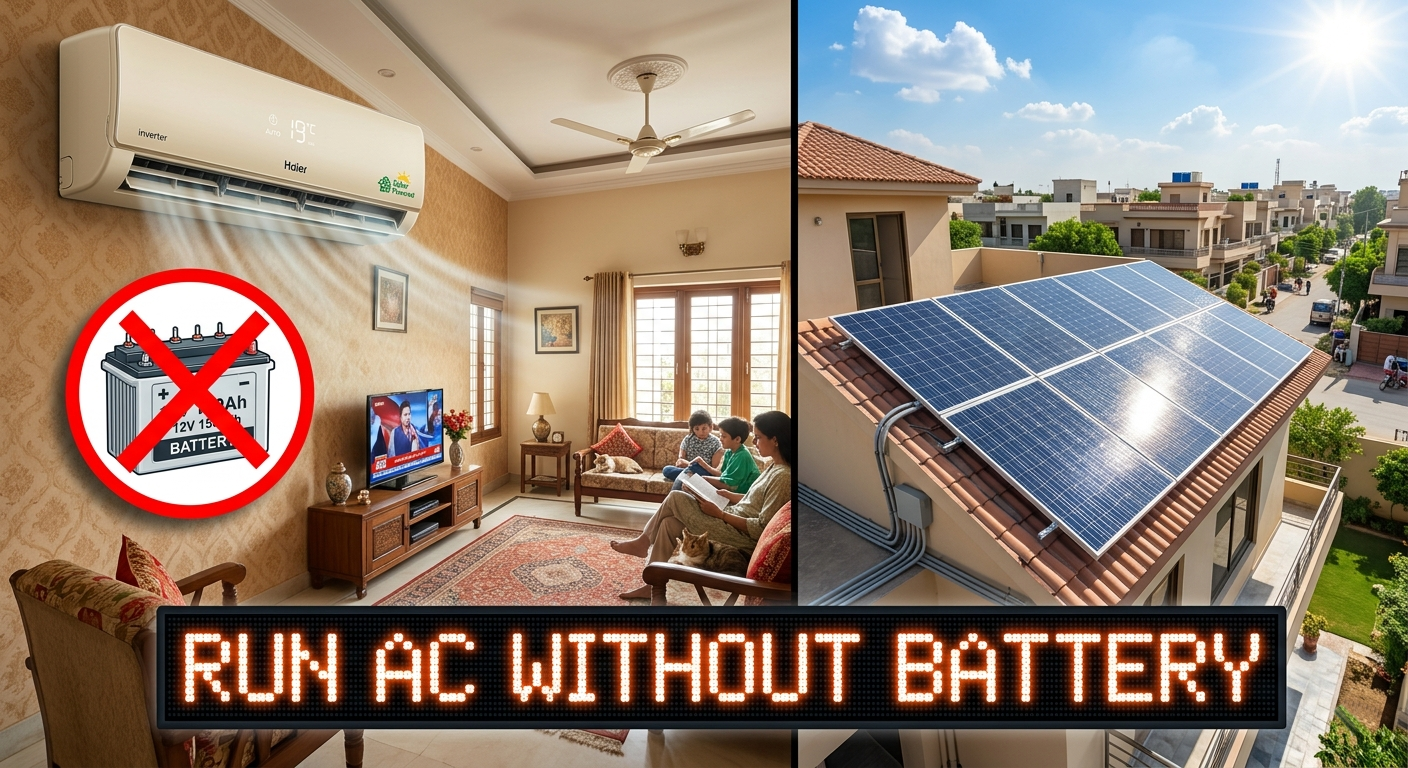
If you want to successfully run an AC on solar without a battery, you are in the right place. With the extreme heatwaves approaching and electricity tariffs breaking all records, running an Air Conditioner has become a luxury. However, when people plan to install a solar setup, the massive cost of lithium or tubular batteries scares them away. Today, we will show you how to bypass this cost entirely.
But is it practically possible to skip the battery? The short answer is Yes! You can absolutely run your 1.5-ton inverter AC directly on solar panels during the daytime. In this 2026 guide, we will explain exactly how this system works, how many panels you need, and the pros and cons of going battery-less.
How Does a Battery-Less Solar Setup Work?
Traditional hybrid systems use batteries to store power and stabilize the electrical current. However, if your only goal is to run the AC during the hot hours of the day (from 10 AM to 4 PM), you can use a direct system.
This is achieved using two main methods:
- On-Grid Solar Inverter: This system mixes solar power directly with your WAPDA grid. If the solar panels produce 1500W and your AC needs 1800W, the inverter will take the remaining 300W from WAPDA, bypassing batteries entirely.
- Solar VFD (Variable Frequency Drive): Mostly used for agricultural water pumps, modified solar VFDs can be used to run Inverter ACs directly on DC power from panels. This is the cheapest method but requires a highly stable sun.
How Many Solar Panels to Run a 1.5 Ton AC?
To successfully run AC on solar without a battery, you need to oversize your panel setup. A modern 1.5-ton DC Inverter AC consumes around 1500 to 1800 watts at peak startup and settles around 800 to 1000 watts once the room is cooled.
Since there is no battery to handle the heavy starting “jerk” (startup current), you must rely completely on panel generation.
- Minimum Requirement: You will need at least 6 Tier 1 Solar Panels (550W each).
- Total Generation: This gives you a total capacity of 3300W. Why double the capacity? Because during cloudy moments or early mornings, panels do not produce 100% of their rated power. Having 3.3kW of panels ensures your AC compressor does not trip when clouds pass by.
Pros and Cons of a Direct Solar AC Setup
Before making a decision, it is important to look at the practical reality of this setup in Pakistan.
Pros:
- Massive Cost Savings: By removing batteries from your budget, your total initial investment is halved.
- Zero Maintenance: No need to check acid water levels or worry about battery degradation over the years.
- Perfect for Day Use: Ideal for offices, shops, or living rooms used primarily during peak daytime hours.
Cons:
- Cloud Sensitivity: Without a battery to act as a buffer, if a heavy cloud covers the sun, your AC will trip and turn off instantly unless you are using an On-Grid hybrid inverter connected to WAPDA.
- No Nighttime Backup: This setup is useless after 5 PM. If you suffer from nighttime load shedding, you will still need to check the latest lithium battery price in Pakistan for evening comfort.
Can This Setup Damage the Compressor?
Many people worry that running an AC on solar without a battery can damage the compressor due to voltage drops. Modern DC inverter ACs have built-in safety protections. However, if a thick cloud suddenly covers the sun, the compressor might trip. To safely run your AC on solar without a battery, using an On-Grid hybrid inverter connected to WAPDA is much safer than a direct VFD, as the grid provides instant backup power during cloud cover.
Final Verdict
Choosing to run AC on solar without a battery is a brilliant financial decision if you want daytime comfort at half the installation price. For the most stable experience, we recommend using an On-Grid inverter setup rather than a simple VFD. Just ensure you invest in high-quality panels and keep them clean to maximize daytime generation.